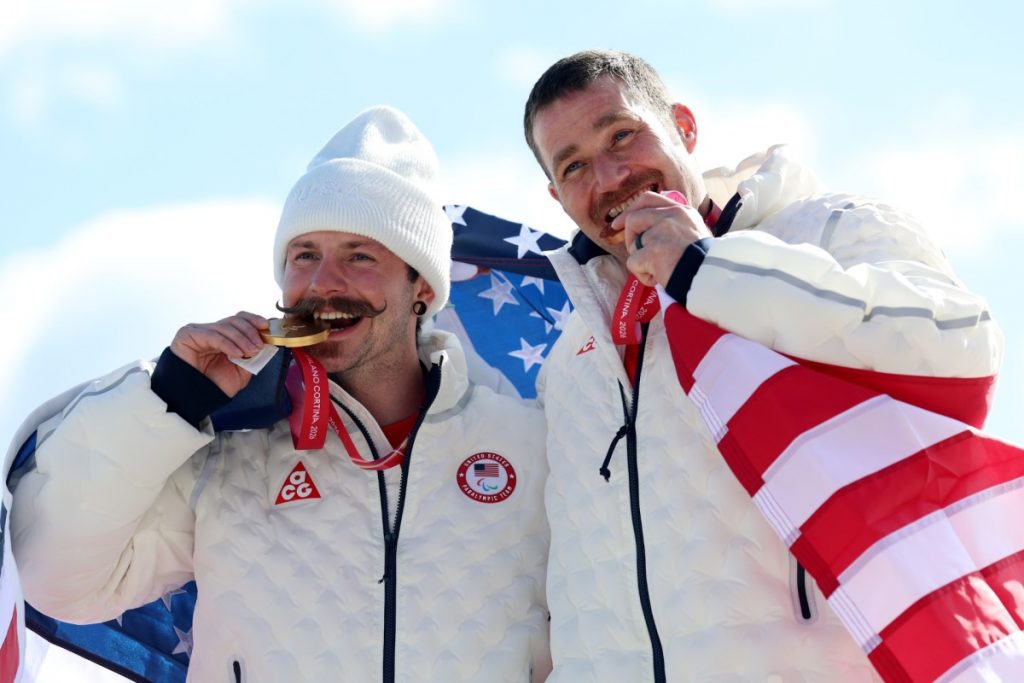
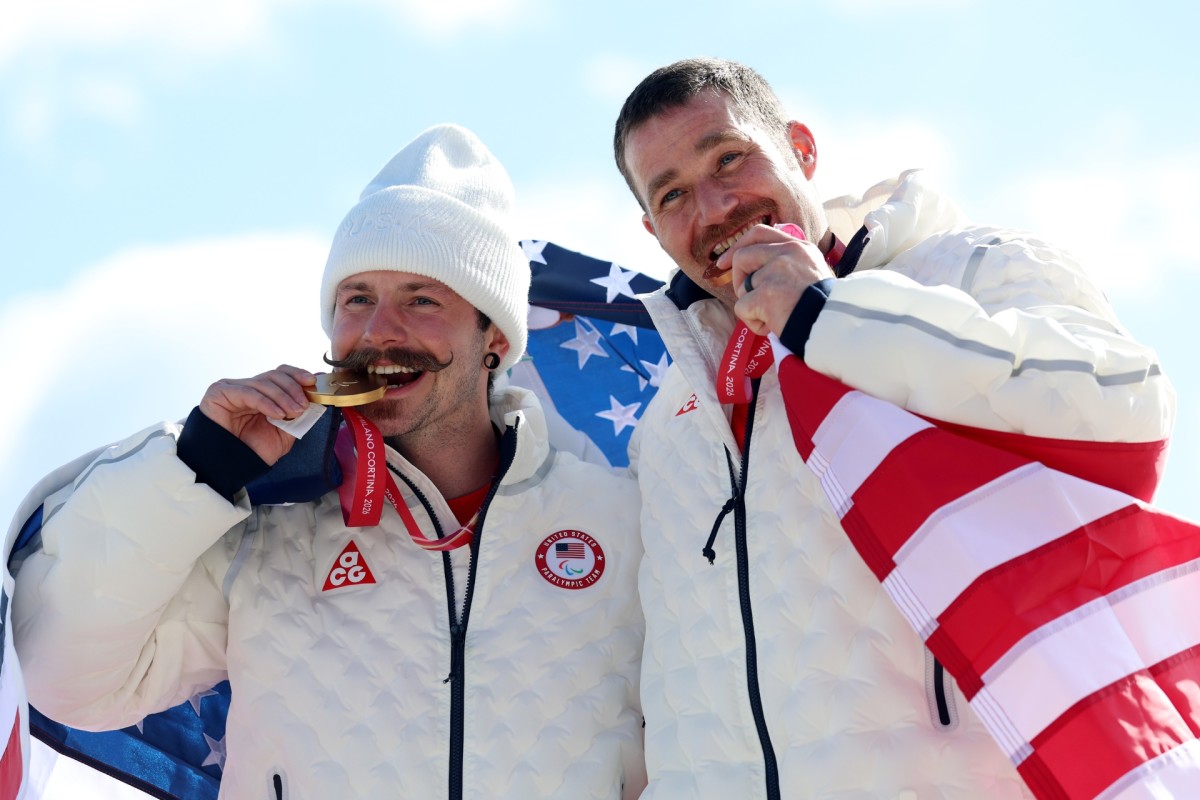
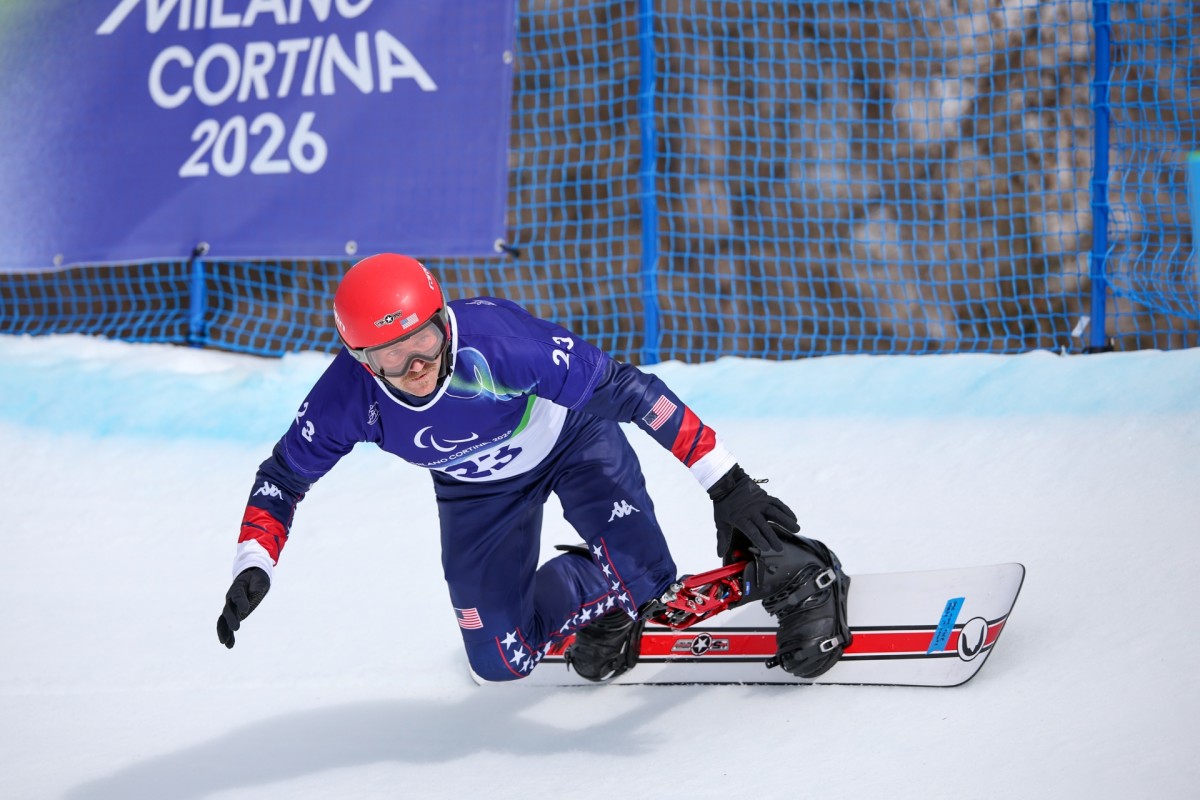
Mike Schultz concluded his illustrious Paralympic snowboard career in style, swiftly navigating the 600-meter Cortina banked slalom course with a best time of one-minute and five-hundredths of a second, good enough for a bronze medal.
He was equally ecstatic to witness his U.S. teammate Noah Elliott flawlessly ride to gold in their SB-LL1 classification, earning the victory on a prosthetic leg that he created for him.
The 44-year-old Schultz, an above-the-knee amputee snowboarder from St. Cloud, Minnesota, has won four Paralympic medals, including two golds, over a prodigious competitive career spanning more than a decade. However, the popular athlete is even more revered for the game-changing, adaptive sports prosthetics that he designs and builds.
The veteran boarder points out that when he loses on snowboard cross or banked slalom courses, it is often to competitors, like Elliott, who are using prosthetics that he has built for them. He deems it a “win-win situation.”
“I love racing with this crew and being a big part of the prosthetic performance for pretty much every other lower limb amputee that’s racing here today and using equipment that I built in my shop, my company, BioDapt, so I can hold my head up high,” Schultz told POWDER at the Cortina Para Snowboard Park.
Elliott, who is unmistakable with his stylish handlebar mustache, commended Schultz’s transformational work, while also sneaking in a quick jab at his significantly elder buddy and teammate.
“It’s always fun to beat him on the leg that he made for you,” said Elliott, who will leave the Paralympics on a high note, with gold and silver medals. “I was very proud about that today, since we really are just best friends now.
“I couldn’t be more proud to be on his product because at the end of the day, he makes the best prosthetics for snowboarding that we’ve seen. To be working with them, BioDapt, over the years and playing with and testing things with Schultz has been such a phenomenal experience,” said Elliott, who completed his full set of Paralympic medals across two Winter Games: gold, silver, and bronze.
Prior to sharing a podium with him on Friday, last weekend, Schultz was narrowly edged by Elliott in his semifinal heat, knocking him out of medal contention. Naturally, the veteran rider was disappointed to see his Paralympic snowboard medal streak snapped, but also stoked for the success of his 28-year-old U.S. teammate, among others.
“I’m more about trying to progress the sport as a whole, and I’m very proud that I could be a part of that,” Schultz said. “The top eight guys are all using BiopDapt equipment: Moto Knees and Versa Feet.
“They’re all modular, depending on foot size and right and left, but everything was built real versatile, so it could be adjusted and calibrated, depending on the snowboarder’s stance, prosthetic in the front or the back.”
Naturally, it was a win-win situation for Schultz in Cortina, as he also celebrated a superb medal-winning showing in his final major race. “To be on the podium and bring home a medal in my last Paralympic Games, man, that feels good. That feels real good,” said the 44-year-old snowboarder.
While Schultz and Elliott proudly shared a podium on a spectacular Friday in the Italian Dolomites, their female teammates Kate Delson and Brenna Huckaby did the same, bringing home gold and bronze, respectively, also in banked slalom. For Huckaby – the most decorated Para snowboarder in history – it increased her Paralympic medal tally to four, including two golds.
Maja Hitij/Getty Images
The “Mad Scientist”
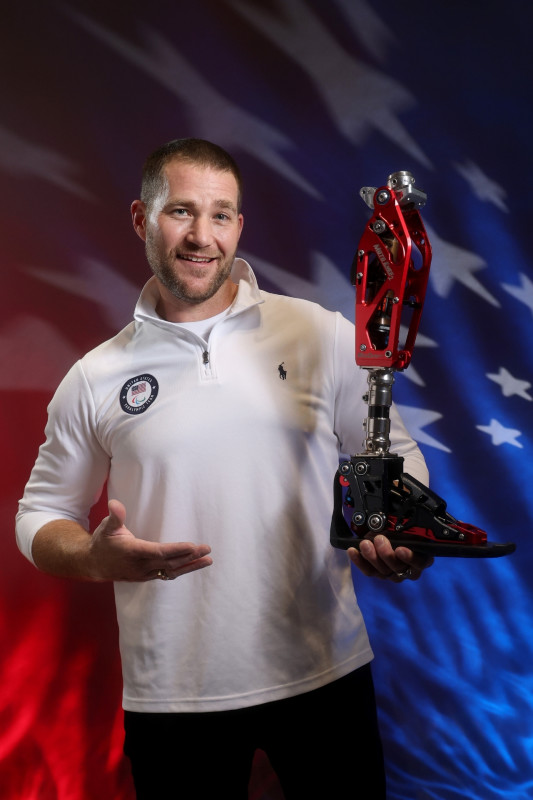
A nasty crash at a snowmobile cross race in 2008 resulted in Schultz sustaining a severe compound fracture to his knee, and after multiple surgeries, he had his left leg amputated above the knee. Seeking solutions to allow him to continue competing in action sports, Schultz designed and developed his own high-tech prosthetic knee, utilizing a patented linkage system and mountain bike shocks.
“I’m a garage guy, and I love to create things with my hands, just having these ideas and building them,” Schultz says. “When I realized prosthetics were pretty limited, as far as action sports, I went full mad scientist in my shop and started to create my own prosthetic leg to get me back into racing dirt bikes and snowmobiles.”
Schultz proceeded to win an adaptive motocross silver medal at the X Games, and began snowboarding shortly thereafter, in 2009.
Marcus Hartmann/Getty Images
The Future of BioDapt
Schultz’s injury led him to found BioDapt Inc. in July 2010. He has been making the Moto Knee available to active amputee athletes ever since. While most of the magic happens at home in his Minnesota garage, Schultz also plays on-mountain mechanic for his fellow Para athletes.
“There’s lots of parts and pieces, and over time, these guys get in crashes or bolts come loose,” Schultz explains. “I always have a 30-pound backpack with some extra parts and hardware. Just the other day, I was fixing (Kosuda) Junta’s leg for him. That boy is hard on his equipment. My tool kit and extra parts and pieces are to help out anybody who needs it.”
Schultz looks forward to greater time and focus, continuing to help the adaptive snowboard community push limits and to progress to even loftier possibilities.
“One of the big reasons that I’m retiring from snowboard racing is so I can spend more time with my business working on some big ideas, and also with my family, of course,” Schultz says.
Mike Coppola/Getty Images
The Next Chapter Awaits
Schultz and BioDapt recently entered into a partnership with San Francisco-based multinational software corporation Autodesk, joining forces to accelerate the next wave of high-performance prosthetics for athletes preparing for the LA 2028 Olympics and beyond. The collaboration builds on months of technical work between Autodesk and Schultz using Autodesk Fusion, the company’s AI-powered manufacturing cloud.
“We’re going to work together and see what we can come up with. I’ve got some big ideas that I’ve been wanting to pursue for a while, but have been too busy with snowboarding,” Schultz says. “Over the next couple of years, we’re gonna be working on some very cool stuff.”
As Schultz’s fearless fellow snowboard racers, who will undoubtedly benefit from his future innovation, creativity, and earth-shaking ideas, will attest, the sky is the limit. And they will no longer have to feel bad about beating the mad scientist anymore.